Manual progress compilation
Physical and financial progress had to be compiled by hand, package by package, division by division.

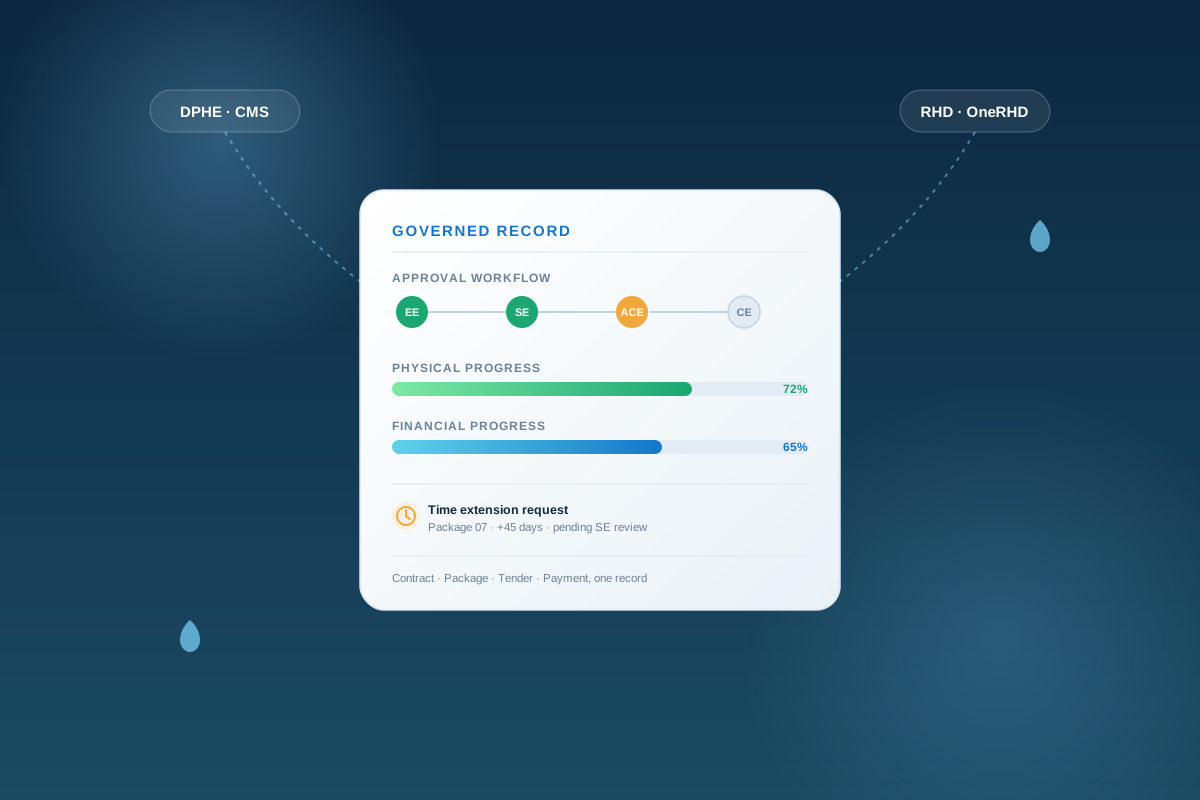 Illustration · representative concept, not a live system screen
Client case study · DPHE · RHD · Contract & progress tracking
Two government agencies needed the same thing: one governed record for contracts, physical and financial progress, and time-extension requests, instead of paper files compiled by hand. DPHE's Contract Management System (CMS) and RHD's ONERHD Contract Management and Work & Payment Tracking modules solve it the same way, independently, for each agency's own approval chain.
Before digitization, tracking a contract at RHD meant compiling package-wise progress by hand — a physical-and-financial progress chart per package, per division, and a separate paper form to request a time extension without a cost increase, each requiring manual sign-off up the chain. DPHE faced the same pattern for its nationwide tender and contract administration. Both needed a governed digital record instead of a paper one.
DPHE owns and operates its Contract Management System (CMS) for the Ground Water Circle's nationwide activities. RHD owns and operates ONERHD, including its Contract Management and Work & Payment Tracking modules, under the Monitoring Division. Both are built on the same underlying approach, independently, for each agency's own approval chain.
Challenge
Physical and financial progress had to be compiled by hand, package by package, division by division.
Requesting a contract duration extension meant a separate paper form and a manual approval chain.
Tender, contract and payment information for each package lived in separate files rather than one record.
DPHE · Contract Management System
CMS administers DPHE's tender, contract and billing activity nationwide, replacing scattered paper files with one governed record for the Ground Water Circle.
Tender, contract and billing administration for DPHE's Ground Water Circle, in one system rather than scattered paper files.
Built for use across DPHE's countrywide activities, not a single project or division.
Tender, contract and billing information sit against the same record instead of separate paper files.
Contract and tender status is visible in the system directly, without reconstructing it from paper each time.
RHD · ONERHD Contract Management & Work and Payment Tracking
ONERHD's Contract Management and Work & Payment Tracking modules are purpose-built around how RHD actually approves and pays for work — package by package, up through the Monitoring Division's chain of command.
Contractor details, performance history and payment progress in one record, replacing scattered package files.
Package number, work name, procurement method, invitation, closing and approval dates, and approved estimated cost, captured for every package.
Once a tender is awarded, the system generates and stores a digital contract with scope, budget, duration and payment terms.
Contracts and payment requests move through Executive Engineer, Superintending Engineer, Additional Chief Engineer and Chief Engineer, digitally.
Milestones, completion percentage and actual-versus-planned progress, with contractor bills verified digitally against approved budgets.
Package-level and contractor-wise reports for Executive Engineers, up to nationwide programme dashboards for the Chief Engineer.
The advantage
Every package's tender, contract and payment status is visible in one place, not scattered across separate files.
Executive Engineer to Chief Engineer sign-off happens inside the system, with a digital record of who approved what and when.
Physical progress, financial progress and time-extension requests sit against the same package record, not separate forms.
This case study describes CMS and ONERHD's Contract Management and Work & Payment Tracking modules as delivered software, grounded in each system's approved scope. No confidential data or internal system screens are reproduced here.
Representative hero illustration; no confidential operational data or contract value is reproduced.
One governed record, any agency.