Technology choice depends on context
Flood exposure, cyclone risk, salinity and hydro-geology all change which WASH technology actually fits — reasoning that wasn't available in one place to query.

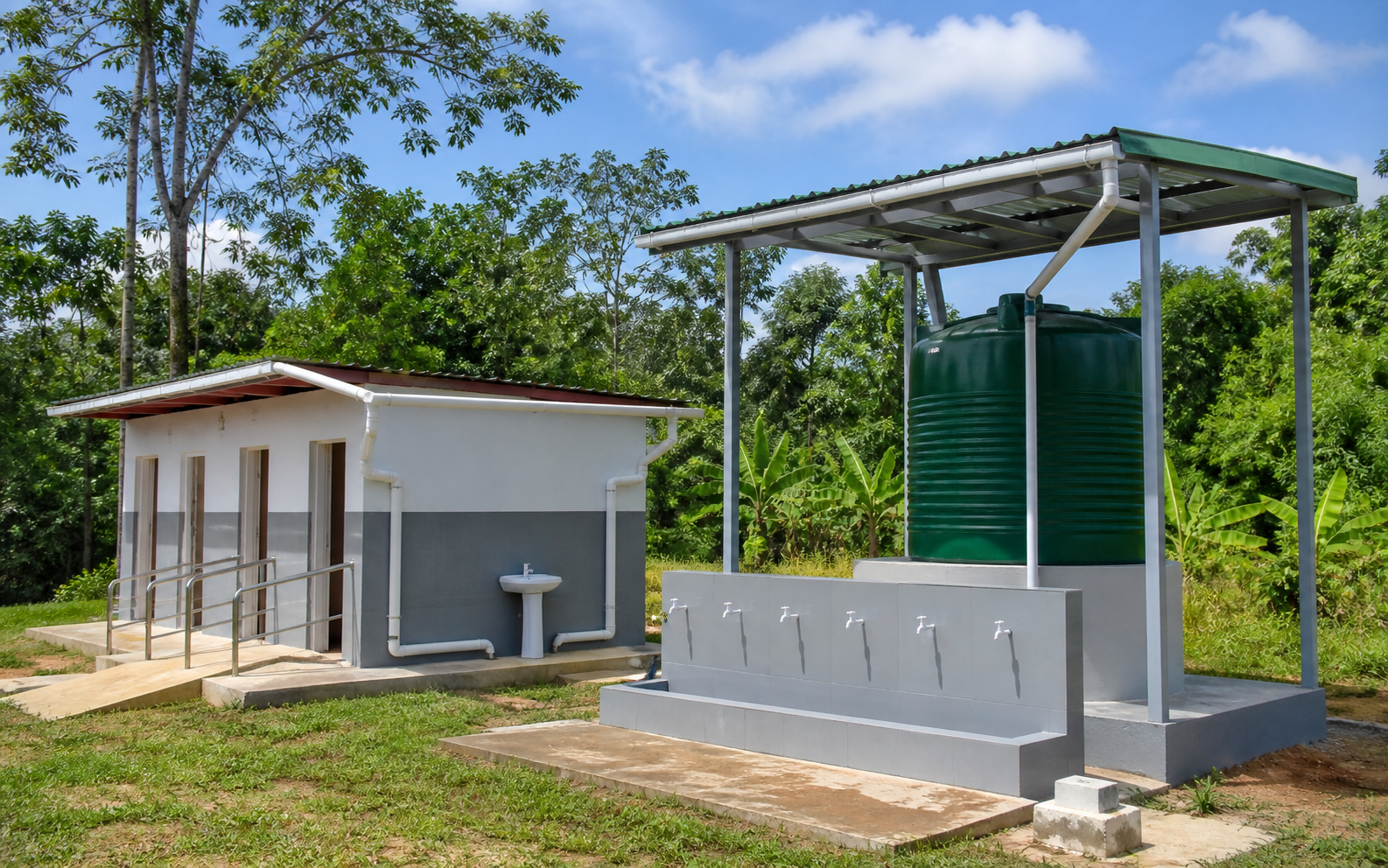 AI-generated representative visual · not a project-site photograph
Case study · DPHE-WASH · AI budget assistant
Tiger Park built and operates a public compendium of water, sanitation and hygiene technologies for Bangladesh's disaster-response sector — complete with real per-technology costs, a live project map, and an AI assistant that turns a plain-language emergency scenario into an itemized budget grounded in that same cost data.
Which water, sanitation or hygiene technology fits a given emergency depends on flood exposure, salinity, arsenic risk and how deep the water table sits — and that judgment historically lived across specialists' heads and long reference documents, not somewhere a field planner could query directly. Budgeting compounded the problem: comparing per-unit costs across dozens of technology options for a specific household count and scenario was a manual, spreadsheet-style exercise, redone from scratch each time.
DPHE hosts the public compendium at its own subdomain, and the initiative sits alongside ITN-BUET, UNICEF and the Bangladesh WASH Cluster's work in the sector. Tiger Park designed, built and runs the system, including Naya, the AI budget assistant.
Challenge
Flood exposure, cyclone risk, salinity and hydro-geology all change which WASH technology actually fits — reasoning that wasn't available in one place to query.
Comparing per-unit costs across technology options for a specific household count and scenario was redone by hand each time, from static references.
DPHE, ITN-BUET, UNICEF and the Bangladesh WASH Cluster each held pieces of this knowledge, with no single public interface bringing technology, cost and location together.
The system
The public site brings the technology catalogue, real cost data, a project map and the Naya assistant together in one bilingual interface, built and hosted by Tiger Park.
Water supply, sanitation and hygiene technologies, each classified for during-disaster or post-disaster response, with technical descriptions and design diagrams.
Every technology carries a costed estimate drawn from the underlying database — from a ৳52,123 dual-platform tubewell to a ৳37.8 lakh desalination system.
WASH project locations plotted across Bangladesh's divisions, filterable by water, sanitation or hygiene, searchable by place name.
Tiger Park's general-purpose AI assistant — running on GPT-OSS 120B — takes a plain-language emergency scenario and returns technology recommendations, engineering rationale and an itemized, multi-scenario budget, grounded in the same cost database, not invented on the fly.
The full public interface is available in English and Bangla.
Structured as a shared resource for DPHE, ITN-BUET, UNICEF and the Bangladesh WASH Cluster, not one agency's internal tool.
Naya in action
Naya is Tiger Park's general-purpose AI assistant, deployed here as a WASH budget specialist. This is an actual conversation with Naya on the public site, captured for this case study — abridged for length, unedited in substance. The costs it cites match the technology database directly.
“I need a budget estimate for providing safe water supply to a flood-affected char area with about 300 households. What technologies would you recommend and what would it cost?”
For a char that experiences regular flooding, the Dual-Platform Tubewell is the most cost-effective and resilient primary solution — the pump head sits on a platform that stays above flood level, and it needs no electricity. A Ring-well can be added where arsenic is a concern; a Tara tube-well can serve as a deep backup source.
What the live system shows
Every cost figure the assistant returns traces back to the technology database, not a guess generated on the spot.
Recommendations account for flood exposure, arsenic risk and seasonal water-table depth — not just a generic technology list.
Multi-technology, multi-scenario cost breakdowns compute correctly, from unit cost through O&M to first-year total.
In ordinary public use today, not a concept or a slide deck.
Where this could go
The system already runs the full loop — catalogue, cost, location and grounded AI guidance. The opportunities below build on that foundation.
Connecting the assistant and catalogue more directly into DPHE and partner agencies' own planning workflows.
Connecting the assistant's cost estimates to live procurement or tender data would keep every figure current automatically.
Additional WASH technologies and regional cost variations could be added as the sector's own reference evolves.
The same grounded-assistant pattern could extend to other national technology-reference needs beyond WASH.
This case study describes the public system at wash.dphe.online as directly observed, including a real exchange with its assistant.
The hero illustration is a representative concept; the budget figures shown match a real exchange with the live assistant. No confidential data or internal system screens are reproduced here.
Grounded AI, built and running