Four different source types
Tube wells, rainwater harvesting tanks, community schemes and piped supply each generate their own records.

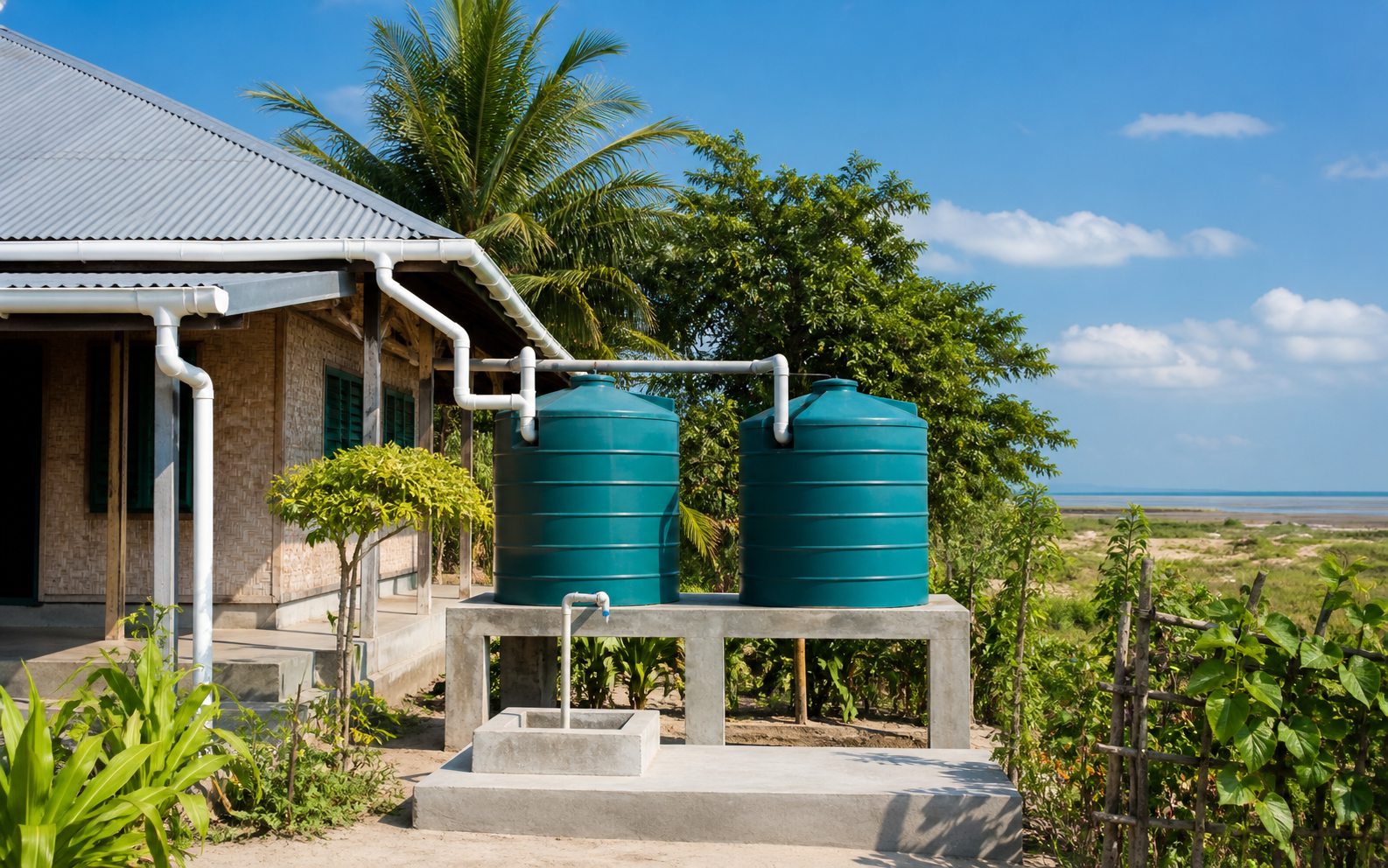 AI-generated representative scene · not a project-site photograph
Client case study · DPHE · Coastal Rain Water Harvesting
For DPHE's Water Supply Project in Coastal Areas through Rain Water Harvesting System, Tiger Park is building Brishtir Pani — a Tiger One and Sky Hawk-based web portal and Android app that brings tube wells, rainwater harvesting tanks, community schemes and piped water supply into one monitored, geotagged record.
Safe drinking water remains scarce across Bangladesh's coastal zone, where existing options are often inadequate or costly to sustain. Rainwater harvesting has proven suitable and economically viable, with growing acceptance among coastal households. DPHE's Water Supply Project in Coastal Areas through Rain Water Harvesting System needed a way to monitor delivery across many source types and locations — beyond what periodic paper reporting could track.
The Department of Public Health Engineering's Project Director for the Coastal Water Supply Project through Rain Water Harvesting System owns the programme. Tiger Park Limited built and supports Brishtir Pani, the system's web portal and Android app.
Challenge
Tube wells, rainwater harvesting tanks, community schemes and piped supply each generate their own records.
Installation, water-quality testing and handover needed geotagged evidence, not paper reports.
Payment and contractor information needed to sit alongside the technical record, not in separate files.
Solution
The system combines a role-based web portal and Android app with a filterable dashboard, so field evidence from tube wells, tanks, schemes and pipelines reaches DPHE without waiting for the next paper report.
The Android app geotags and photographs every source on site, storing submissions locally until a connection returns.
Tube wells, rainwater harvesting tanks, community schemes and piped supply each get their own structured record.
Laboratory test results, including fecal coliform, are linked to each community water-supply scheme.
Filterable by location, component, progress status and contractor, down to union level.
Invoices and payments sit alongside the delivery record, package by package.
Data entered by field staff is reviewed and approved by senior staff before it becomes part of the record.
Representative management view
Brishtir Pani is designed to connect programme status with source-level evidence. A management view can place physical and financial progress beside Sky Hawk photographs, water-quality follow-up, geographic filters and maker-checker approval—without separating the chart from the record that supports it.
Representative interface built for this public case study. It contains no live DPHE screen, project figure, contractor record or identifiable site data.
Proven foundation
Tube wells, tanks, community schemes and piped supply no longer need separate paper trails to stay accountable.
Brishtir Pani runs on the same Tiger One and Sky Hawk foundation already delivering CEIP-1 and DPHE's earlier water-supply monitoring.
Ongoing operation and maintenance support keeps the system running, with source code and documentation held by DPHE.
Built to extend
User management, roles and permissions were built in a generic style — so the same foundation can carry future DPHE water-supply programmes, not just this one.
User management, roles and permissions were built in a generic style, not specific to rainwater harvesting alone.
The same platform already supports CEIP-1, PEDP4 and DPHE's earlier water-supply monitoring systems.
This case study describes Brishtir Pani as delivered software, grounded in its approved scope for DPHE's coastal rainwater harvesting programme. No confidential data or internal system screens are reproduced here.
The hero is an AI-generated representative coastal installation, not a project-site photograph. The dashboard is a public-facing concept with fictional indicators; no confidential operational data or contract value is reproduced.
One record, every source type.